Dunialy Script Font for Elegant Wordmarks
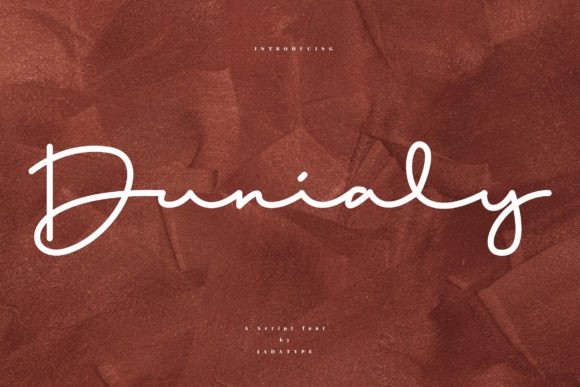
There I was—mid-morning light, coffee cooling, brand board open in Figma—and staring at a blank logo placeholder for a new handmade ceramics studio. The client wanted warmth, authenticity, and quiet confidence—not flashy, not trendy, just *human*. I dropped in Dunialy. Instantly, the wordmark felt like something signed with intention: fluid but controlled, personal but polished. That’s the first thing you notice about Dunialy: it’s a Script Handwritten font built on monoline lines, so there’s no contrast between thick and thin strokes—just clean, consistent rhythm. It doesn’t shout. It leans in.
Dunialy for Wedding Invitations and Elegant Branding
I tested Dunialy on a set of wedding invitation mockups—letterpress-style paper, soft ivory stock, minimal layout. It held up beautifully. Because Dunialy is a script font with monoline lines, it avoids the visual “busyness” that heavier scripts can introduce at small sizes or in tight compositions. On RSVP cards and envelope liners, it read as refined, not fussy. It’s especially effective when used sparingly: the couple’s names as a centered wordmark, a single line of script for “Join us” beneath a delicate serif body font. Dunialy isn’t meant for long paragraphs—but as a Fonts choice for high-touch, emotionally resonant moments like weddings? It delivers presence without pretension.
Dunialy for Craft Business Cards and Packaging Labels
Next, I applied Dunialy to a set of ceramic mug labels and business cards for that same studio. Printed on uncoated kraft paper, the font kept its clarity—even at 10 pt on a curved label. Why? Monoline construction means no hairline strokes to break up or disappear in offset or digital print. Dunialy works best as a display font or accent font—not for body copy—but it shines where personality matters most: on a jar of small-batch honey, stitched onto a linen tote, or foil-stamped on a gift box. As a Script Handwritten typeface, it feels tactile and intentional, like something made by hand rather than generated. Just be sure to test spacing: some letters (like “f” and “y”) carry subtle entry/exit strokes that benefit from slight tracking adjustments in tight layouts.
Dunialy for Social Media Graphics and Website Headers
I dropped Dunialy into an Instagram story template and a homepage hero section—paired each time with a warm, neutral sans serif (think Inter or Manrope) for balance. The contrast worked instantly: Dunialy as the emotional anchor, the sans as the grounded voice. As a Fonts option for web use, keep in mind Dunialy is best deployed as a headline or logo font—not for navigation or paragraph text. Its strength lies in recognition, not readability at scale. On mobile, I resized it generously and added subtle letter-spacing to avoid crowding. For social media graphics, Dunialy performs strongest in static visuals (not animated text), especially when layered over soft textures or muted photography. It reads as calm, confident, and quietly luxurious—ideal for creative studios, artisanal brands, or boutique services where tone is as important as typography.
Dunialy for Event Branding and Handmade Shop Identity Systems
In a recent local event branding refresh—think seasonal maker fair, community art pop-up—I used Dunialy across banners, signage, and digital announcements. Paired with a sturdy geometric sans for practical info (“Sat, Oct 12 • 10am–6pm”), Dunialy handled the emotional lift: “Gather • Make • Share” in flowing script. That duality is where Dunialy excels. It’s not a standalone system—it’s a collaborative Fonts partner. As a Script Handwritten typeface, it needs breathing room and thoughtful pairing. Avoid stacking it with other scripts or overly decorative fonts; let it breathe beside strong, simple serifs or humanist sans fonts. Also worth noting: Dunialy is designed for short phrases and wordmarks, not extended editorial design or data-heavy layouts. If your project involves legal disclaimers, ingredient lists, or multi-language support, verify whether the font includes extended Latin characters—or plan to switch to a supporting typeface for those sections.
Before locking Dunialy into final client files, always check the license. Most versions include OTF/TTF files suitable for desktop use, but if you’re embedding it in a Shopify theme, selling Canva templates, or printing on merchandise, confirm commercial rights are covered. And always test—print a few samples, view on multiple screens, ask a colleague to read the wordmark aloud. Dunialy gives the impression of a signature that is suitable for wordmarks, yes—but only when it serves the brand, not the other way around.