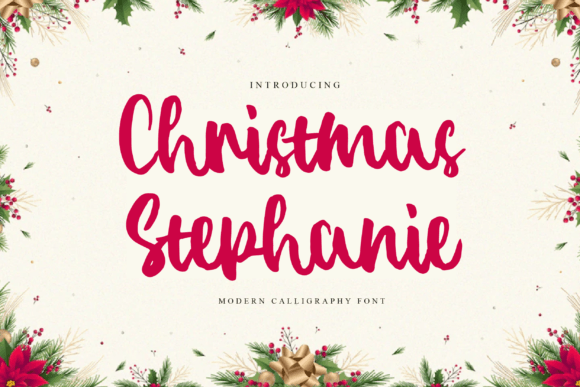
Christmas Stephanie Font for Warm, Romantic Branding
Two weeks before the holiday season, I sat at my kitchen table—surrounded by candle jars, blank labels, and three half-finished versions of my new “Winter Glow” scent label—realizing something was missing. Not the scent, not the color palette, not even the hand-poured wax. It was the *feeling*. My brand felt polite but forgettable—like a friendly neighbor you wave to but never invite in. That’s when I tried Christmas Stephanie, and everything softened into place.
Christmas Stephanie for Handwritten Holiday Packaging Labels
Christmas Stephanie is a Script Handwritten font that carries quiet romance—not flashy, not fussy, just tender and intentional. As a small-batch candle maker, I needed a font that could live on 2-inch jar labels without shrinking into illegibility or shouting over the product. Christmas Stephanie works beautifully at 14–18pt on matte kraft labels: its gentle curves and natural flow echo handwriting, but with consistent spacing and clean terminals—no shaky wobbles, no awkward gaps. Because it’s PUA encoded, I accessed alternate lowercase “a” and “g” glyphs instantly in Illustrator, giving each label subtle personality while keeping the brand cohesive. No more copying-and-pasting from free fonts that break mid-sentence or vanish when exported.
Christmas Stephanie for Social Media Graphics and Instagram Story Highlights
I used Christmas Stephanie as my go-to display font for all holiday-themed social media graphics—especially Instagram story highlights like “New Arrivals,” “Holiday Hours,” and “Gift Guide.” Paired with a light sans serif (I love Montserrat Light), Christmas Stephanie adds warmth without sacrificing clarity on mobile screens. Its Script Handwritten charm makes “Hand-Poured Since 2020” feel personal, not promotional. And because it’s a premium Fonts choice—not a Google Fonts substitute—it signals care in curation. Customers notice that difference: one repeat buyer DM’d me saying, “Your stories look like they’re made *for* me—not just *at* me.” That’s the power of choosing the right script font early in your visual stack.
Christmas Stephanie for Elegant Thank-You Cards and Small-Business Stationery
My thank-you cards used to be printed in a generic script that looked like every other Etsy shop’s. With Christmas Stephanie, they now feel like tiny love letters—deliberate, intimate, and quietly luxurious. I use it only for short phrases (“With warmth,” “Grateful for you,” “Light & love”)—never body text—and always pair it with a crisp serif (like Playfair Display) for the address block. The PUA encoding meant I could easily insert decorative flourishes (swashes, ligatures, and stylistic alternates) as subtle accents above or below the signature line—no font-switching gymnastics required. For small business owners sending 50+ cards per week, that consistency saves time *and* deepens connection.
Christmas Stephanie for Café Menus and Seasonal Menu Boards
A local café owner friend tested Christmas Stephanie on her chalkboard-style holiday menu board—and it transformed how customers lingered. She used it for drink names (“Spiced Maple Latte,” “Cranberry Rose Spritz”) over a clean sans serif for prices and descriptions. The Script Handwritten rhythm gave each item breathing room and emotional resonance. Even though it’s a display font—not meant for paragraphs—it performed reliably at 36–48pt on printed vinyl and digital menu displays. Bonus: because Christmas Stephanie includes full Latin character support and standard punctuation, she didn’t hit roadblocks with accented specials like “Crème Brûlée Hot Chocolate.”
Christmas Stephanie for Boutique Gift Tags and Product Packaging Titles
If your packaging lives on shelves beside big brands—or gets unboxed on TikTok—you need typography that earns attention *and* trust. Christmas Stephanie delivers both. I used it for the front-of-box title on my limited-edition holiday gift set (“Winter Glow Collection”), then switched to a minimalist sans for ingredients and care instructions. The contrast felt intentional, not accidental. As a Fonts purchase, it came with OTF and TTF files, basic OpenType features, and clear commercial licensing—so I could confidently use it across physical tags, Shopify banners, and printable PDF gift notes. No guesswork. No copyright anxiety.
Christmas Stephanie for Logo Design and Brand Identity Refreshes
Let’s be real: most small businesses don’t redesign logos every year. But when you do, Christmas Stephanie is a surprisingly strong candidate for secondary logotype elements—especially if your brand leans into warmth, nostalgia, or handmade authenticity. I used it for the tagline beneath my logo (“Slow Light. Steady Glow.”) and kept the primary mark in a refined serif. The result? A balanced identity system where Christmas Stephanie adds humanity without undermining professionalism. It’s not a standalone logo font (it lacks bold weights or tight kerning for all-caps impact), but as part of a thoughtful Script Handwritten + structured type pairing, it elevates everything around it.
Christmas Stephanie for Digital Ads and Holiday Email Headers
In crowded inboxes and fast-scrolling feeds, your email header has under two seconds to say, “This is worth your time.” Christmas Stephanie helped mine do exactly that. I used it at 42pt in Mailchimp for subject-line previews (“You’re Invited to Our Holiday Pop-Up 🎁”)—then dropped to a clean sans for the rest. Its Script Handwritten elegance slowed the eye just enough to create pause, while its PUA-encoded glyphs ensured emojis and special characters rendered cleanly across devices. No pixelation. No substitution. Just calm, confident, commercial-grade Fonts performance.
Choosing Christmas Stephanie wasn’t about chasing trends—it was about finding a Script Handwritten voice that matched how I wanted customers to *feel* when they saw my brand: seen, cherished, and gently invited in. It’s the kind of Fonts investment that pays off quietly—on labels, in stories, on cards, and in moments that seem small until they become the reason someone remembers you.